Published October 29, 2026 · Independent educational guide
Read a Process Diagram Before Asking AI for a Checklist
A process diagram in a business book can look like a ready-made procedure before you have established what its arrows mean. A line may indicate sequence, information, responsibility, a feedback relationship or something defined only in a legend. If an AI explanation assumes every arrow means do this next, it can turn a conceptual picture into instructions the source never supplied. Read the relationships before asking for a checklist.
Start with the diagram's identity, caption, legend and surrounding discussion in the edition you are actually using. Keep those source details distinct from your own proposed application. A picture can help frame a question without authorizing an action or proving that a process works. The practical goal is to prepare a reviewable description of the supplied structure, then identify what additional evidence would be needed for a procedure or operating decision.
This guide uses six original fictional diagrams represented as small node and edge records. Their labels, rules and proposed readings are teaching inputs, not figures from an actual book, manuscript or company process. No model output, operating workflow, source image inspection, professional review or author endorsement is claimed. Local checks concern literal nodes, directed connections, labels and selection counts, not the accuracy of an actual business method.
Preserve the information carried by the picture
The W3C Web Accessibility Initiative discussion of complex images identifies flow charts and other diagrams as images that may need a fuller textual representation of essential information. That limited descriptive context was read October 29, 2026. This guide uses the question of what information a description must preserve. It does not implement an accessibility standard, audit a book or certify that a particular description meets an individual's needs.
For a process figure, a useful description names the nodes, directed connections, branch labels, grouping and relevant legend. It also records unresolved visual relationships. Merely listing the words inside boxes can lose the structure that makes the diagram meaningful. Conversely, describing a structure does not establish that the labels are accurate or that the process is suitable for a real organization. Keep transcription and evaluation as separate tasks.
An AI assistant receiving your text description is reading that description, not independently inspecting an unavailable image. If a crop omits a legend or the arrowhead is unreadable, say so. Do not fill the gap from a familiar management framework or a plausible sequence of work. A faithful unresolved field is more useful than a polished account of a diagram that was never supplied.
Before asking for a summary, choose what the reading note should answer. Are you identifying the claimed sequence, comparing two branches, tracing a feedback loop or asking what the chapter says the diagram illustrates? Those tasks require different details. A bounded request can preserve the figure's relationships without inviting the assistant to invent an implementation plan from a conceptual illustration.
Case A: arrow direction changes the supplied sequence
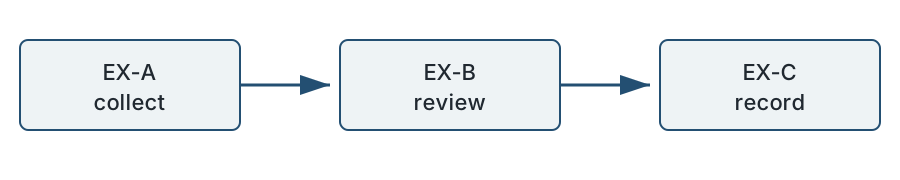
The first fictional diagram has nodes EX-A labeled collect, EX-B labeled review and EX-C labeled record. Its directed edges are EX-A to EX-B and EX-B to EX-C. Under the explicitly authored sequence convention, collect precedes review and review precedes record. The displayed teaching diagram illustrates these three nodes and two arrows. It is original educational material, not a quotation, screenshot or model-generated account of an actual book figure.
A proposed description that lists record, review, collect reverses the supplied order. The same three labels appear, but their relationship changes. An AI request should therefore ask for directed edges as well as node names. A membership check alone would miss the reversal. A useful note retains the order and states that it follows the supplied sequence convention rather than implying that every real arrow uses that meaning.
The example contains no performer, calendar, input quality or completed task evidence. It does not establish that a real review occurred or that collecting information is sufficient preparation for it. A diagram can specify a proposed relationship while leaving the activities themselves undefined. If an operating checklist is needed, those definitions and authorities must come from the relevant actual context, not from the assistant's guess about familiar verbs.
When comparing a figure with a prose summary, trace one complete path and check each transition. This can expose a missing or reversed relationship. It is a narrow consistency check, not validation of the source's business argument. A correctly transcribed sequence can still be incomplete, ineffective or unsuitable for a reader's proposed use. Preserve what the figure states before asking the separate question of what it supports.
Case B: branch labels determine which path a condition selects
The second fictional diagram contains a decision node labeled approved? Its yes edge leads to an authored node called send, while its no edge leads to revise. The labels yes and no belong to the edges, not merely to the page as decorative words. A reading note that removes them leaves the branches' conditions unresolved. One that swaps them describes a different rule from the supplied teaching record.
A bounded AI request can ask for the decision text and each labeled outgoing edge separately. Then ask which destination follows under a supplied fictional condition. In this case, a true condition selects the yes edge to send, and a false condition selects the no edge to revise. Those are literal mappings within an invented diagram. They do not establish that a real request is approved or authorize anyone to send a message.
The distinction between a described branch and an operating authorization matters when AI is involved. A source figure may discuss approval conceptually without naming who can grant it, what evidence counts or which action is permitted. Do not turn a box labeled send into permission to contact someone. Keep the diagram's meaning separate from the actual task authority and the user's instructions in the workflow where it might be applied.
An unclear branch label should remain unclear. If the image contains two outgoing arrows but their labels are cropped or unreadable, the assistant cannot recover the intended mapping from the destination names alone. It can identify the missing relationship and ask what evidence would resolve it. A plausible guess that approval probably leads to sending is not the same as reading the actual edge label.
Case C: branching does not establish the order of sibling tasks
The third authored diagram has edges from EX-A to EX-B and from EX-A to EX-C, with no edge between EX-B and EX-C. Under its declared dependency convention, A precedes each of the other nodes. Both sequences A, B, C and A, C, B respect those supplied edges. The diagram does not impose B before C or C before B. Choosing one order for a textual list adds a presentation choice.
A list can be useful if that choice is labeled. Ask AI to preserve the dependency structure and identify when several written orders fit it. Do not let a numbered summary create a new dependency between the sibling tasks. Conversely, the lack of an ordering edge does not prove that the tasks can actually run simultaneously. Real resources, inputs and constraints are absent from the fictional record.
This distinction prevents a conceptual diagram from becoming an unsupported scheduling claim. A reader may need to know whether two tasks share a person, system or prerequisite not shown in the figure. The diagram alone does not answer that. A useful follow-up question asks what the chapter says about the branch relationship and what additional implementation constraints would matter in a real setting.
If a later version adds an edge from B to C, record it as a structural change even if the node labels remain identical. An AI summary that compares only the boxes would miss the new relation. Keep the edge list and its interpretation with the figure's version or locator so another reader can see why the set of permissible orders changed.
Case D: a loop does not supply its own stopping condition
The fourth fictional diagram has an arrow from EX-A to EX-B and another from EX-B back to EX-A. It contains a directed cycle of length two. Under its authored process interpretation, following the arrows can return to an earlier node. The record supplies no exit condition, iteration count or success criterion. A summary saying repeat exactly three times would add a rule absent from the diagram.
A loop can raise useful reading questions: what changes between passes, what evidence ends the loop, and whether the surrounding text describes a retry, a review cycle or feedback. Those are possibilities to investigate, not meanings guaranteed by a circular line. Ask the assistant to distinguish the visible return connection from any proposed explanation of it. The figure's caption and chapter discussion may be necessary to resolve the intended role.
Do not infer that a real system will run forever merely because a simplified conceptual diagram omits an exit. The source may abstract away a condition explained elsewhere, or the available crop may be incomplete. Likewise, do not invent an exit to make the model appear operationally complete. Preserve the missing rule and identify the relevant source material that would be needed to assess it.
For an actual implementation proposal, a stopping rule would be only one of several necessary choices. Error handling, authority, retained state and effects of repeating an action may matter. This guide implements none of those. It helps a reader see that a drawn return arrow and a fully specified repeatable procedure are different objects, even when an AI-generated checklist makes the transition between them sound effortless.
Case E: the legend can give visually similar lines different meanings
The fifth fictional record defines solid arrows as sequence and dashed arrows as information transfer. Its solid edge connects EX-A to EX-B, and its dashed edge connects EX-C to EX-B. The record therefore states one sequence relationship and one information relationship. Treating both edges as task order would change the supplied legend. Treating the dashed edge as physical movement would invent another meaning not present in the example.
A useful AI description should name the line style and its declared meaning together. If the source uses color as well, preserve the legend mapping without relying on color alone in a text note. The objective is to keep the relationship readable after the picture is absent. That does not require adopting a universal rule that dashed lines always mean information; this meaning belongs to this explicitly authored legend.
The same visual mark can carry different meanings in another figure or edition. A reader should retain each figure's own legend rather than import one from an earlier chapter. If two diagrams are compared, align their definitions before comparing their edge patterns. A changed legend can change an interpretation even when the drawn nodes and lines look similar. An assistant that recognizes a familiar visual style still needs the actual source definition.
A missing legend is therefore a substantive gap. Ask AI to describe what is visible and list the meanings that remain unresolved instead of choosing the most plausible convention. This keeps the note faithful to the supplied evidence. It also helps a reader identify a concrete next step: inspect the caption, legend or surrounding text that explains the mark rather than search for a generic interpretation of the symbol.
Case F: a cropped path does not establish the complete process
The final fictional source inventory names nodes EX-A, EX-B and EX-C, but the supplied crop shows only A and B. A connector leaves the crop boundary and its destination is uninspected. Two of three named nodes are present in the selected representation. That fraction describes the supplied node selection, not understanding, completeness of the real process or the proportion of a chapter's argument represented by the crop.
An AI summary should not call B the final step merely because it is the last complete box visible. The outgoing connector indicates an unresolved continuation in the authored record. Nor should it assume the unseen destination is C without a supplied mapping. The inventory and crop relationship need to be established. The example intentionally leaves that connection open rather than pretending the most likely continuation was observed.
A practical note can mark the image as partial, list the visible nodes and preserve the unresolved boundary. It can still support a limited question about the visible A-to-B relationship if that edge is supplied. When a follow-up task requires the full process, obtain and inspect the missing context. Do not let an assistant expand a partial view into a complete operating narrative based on the chapter title.
The same principle applies to a text extraction that omits shapes, arrowheads or labels. Missing from the extraction is not the same as absent from the original. Keep source availability and inspection status separate. A reader can continue useful work on the known portion while retaining the gap, without claiming that the unseen figure is defective or that the complete material is globally unavailable.
Describe the diagram before translating it into a task list
A plain-text representation can begin with the figure's identity and stated purpose, followed by nodes, directed edges, branch labels, grouping and legend. Retain the original labels where authorized and relevant. Put any proposed interpretation in a separate section. This arrangement makes it possible to check whether the assistant preserved the structure before debating whether its explanation of the business meaning is persuasive.
Avoid automatically treating spatial arrangement as time. A box on the left may precede another under a stated sequence convention, but position alone might instead indicate a category, role or comparison. Use the actual arrows and source explanation. Likewise, a larger box does not automatically mean more effort, greater authority or a longer duration. Those meanings require a legend or relevant discussion rather than a visual impression.
When a diagram combines different relationships, consider describing each kind separately before producing one narrative. Sequence edges, information edges and containment groups can coexist without being interchangeable. A single sentence saying everything flows to the manager may erase those distinctions. A concise edge table can preserve them and give a reader a clearer question to take back to the source.
If a group boundary matters, record which nodes belong inside it and what the boundary is said to mean. A department, phase, system or hypothetical scenario can all be drawn as an enclosing region. This guide supplies no universal boundary semantics. Ask AI to preserve the source's definition and identify unknown membership rather than infer responsibility from where a box happens to be placed.
Use AI for a bounded reading task
A useful prompt asks the assistant to separate supplied structure, source explanation, reader interpretation and unresolved questions. Require it to state when a path, branch or legend is missing. If the task is a checklist draft, ask which details were added to make the description procedural. Added detail can be useful as a proposal, provided it is not attributed to a book or presented as an already authorized operating rule.
Review verbs that imply action or evidence. Shows, proposes, requires, confirms and completes do different work. A diagram may propose a relationship without requiring the reader to execute it. A box labeled review does not confirm that a review occurred. A final node does not establish a completed outcome. Precise verbs help keep a reading note from becoming an invented report of actions or results.
For a small example, check nodes and edges independently. Confirm that every included edge has its correct source, destination, label and declared type. Then trace a selected path under the supplied convention. These are consistency checks on a representation, not proof of a real process's effectiveness. A perfectly transcribed diagram can still leave an argument unsupported or an implementation underspecified.
When comparing editions or revised diagrams, retain both source identities and record the changed relationships. The same node labels can appear with reversed arrows, new branch conditions or different grouping. Those changes can matter even if a text comparison of box contents finds no difference. A review should identify what actually changed before interpreting it as a new method, a correction or a measured improvement.
Connect the figure to the surrounding argument
After the structure is clear, read how the chapter uses it. Does the prose describe an example, make a general recommendation, illustrate a hypothetical mechanism or report observed evidence? Those roles have different implications. A figure that is useful for explaining a concept does not automatically supply evidence that the concept produced a business result. Keep the source's stated role attached to any summary.
If you want to apply the idea, write that as a separate proposal with its own questions and evidence needs. The proposal can be inspired by a reading without being the author's method or endorsement. An AI assistant can help organize the proposal, but it should not invent a quotation, chapter instruction, client success or professional approval to support it. Traceability is more useful than an impressive attribution that the source does not establish.
A short final note can identify the figure, preserve its key relationships, state one bounded interpretation and list the most important unresolved question. Its value comes from keeping those parts connected. A longer checklist is not automatically a closer reading. Prefer an account that another reader can compare with the actual source and revise when the missing legend, caption or passage becomes available.
Frequently asked questions
Does every arrow mean do this next?
No universal meaning follows from the mark alone. Use the figure's legend, labels and surrounding explanation to identify sequence, dependency, information or another relationship. If that context is missing, preserve the uncertainty. An AI assistant should not turn a familiar-looking diagram into procedural instructions without evidence of the intended meaning.
Can a list of box labels replace a diagram description?
It can preserve node words while losing direction, conditions, grouping and feedback. Include the relationships needed for the reading question. A complete node list does not establish a complete structural account, and a structurally complete account does not validate the source's business claim or authorize an action.
Do two branches imply that tasks run simultaneously?
The fictional dependency case establishes that A precedes B and C, without ordering B against C. Actual concurrency requires information about resources and constraints not supplied by that graph. Preserve the distinction between several permissible written orders and a real scheduling or execution claim.
Does a loop specify how many times to repeat an action?
A return edge alone does not supply an iteration count or stopping condition. Inspect the source explanation and leave missing rules open. Do not invent a maximum number of attempts or conclude that a real system runs forever from an incomplete conceptual picture. This guide executes no operational process.
Can AI complete a cropped flowchart from context?
It can propose a hypothetical continuation, but that is not inspection of the missing source. Label the crop and unresolved connectors, then obtain relevant context if the task needs a complete account. A plausible completion must remain a proposal and should not be attributed to the book or treated as an authorized procedure.
Are these diagrams taken from an actual business book?
No. The nodes, edges, labels and displayed example are original fictional teaching material. Local checks cover their supplied structure only. No manuscript, book quotation, model output, operating result, accessibility assessment, professional review or author endorsement was inspected or established by this guide.
Original fictional practice data
Original fictional teaching cases, not actual client records, reservations, model outputs, professional review or operating approval. No executable utility is supplied.
| fictional case | authored inputs | bounded result |
|---|---|---|
| A | {"nodes": ["EX-A", "EX-B", "EX-C"], "labels": ["collect", "review", "record"], "edges": [["EX-A", "EX-B"], ["EX-B", "EX-C"]], "orders": [["EX-A", "EX-B", "EX-C"], ["EX-C", "EX-B", "EX-A"]]} | Three nodes/two directed edges; ABC follows declared sequence, CBA does not |
| B | {"question": "approved?", "branches": {"yes": "send", "no": "revise"}} | Two conditional mappings, not authorization |
| C | {"nodes": ["A", "B", "C"], "edges": [["A", "B"], ["A", "C"]], "orders": [["A", "B", "C"], ["A", "C", "B"]]} | Both supplied orders respect arrows; no B-C edge or actual concurrency |
| D | {"edges": [["A", "B"], ["B", "A"]], "exit": null, "iterations": null} | Two-edge cycle; no supplied exit or repeat count |
| E | {"edges": [{"from": "A", "to": "B", "type": "sequence", "style": "solid"}, {"from": "C", "to": "B", "type": "information", "style": "dashed"}]} | Two arrow roles under invented legend; not universal ordering |
| F | {"inventory": ["A", "B", "C"], "selected": ["A", "B"], "outboundInspected": false, "destination": null} | Selected2/3; continuation unresolved, not complete coverage or final B |
Primary sources and editorial scope
AI-assisted website editorial. Sources read October 29, 2026 America/New_York. Original fictional teaching inputs and planning records only; no actual ticket, reservation, visit, inquiry, artwork/material observation, experiment, route inspection, individual access assessment, professional review or institutional endorsement. Original examples checked independently. No record change, actual client dataset, observed model output, professional review, security certification or operating approval is asserted.